Japan's junior high entrance exam (中学受験) is one of the most demanding pre-adolescent academic selection processes in the world. Children aged 10 to 12 sit competitive arithmetic, language, science, and social studies exams designed by elite private junior high schools. The arithmetic in particular is structured to test perception of problem structure, not calculation speed. This piece is written by the founder of an Osaka-based school that focuses on practice-based instruction. The position it takes is one I have arrived at over a decade of working inside the industry — not a thesis the industry agrees with.
Arithmetic was not designed to train the cognitive skill I am about to describe. I do not believe the people who built the modern Japanese arithmetic curriculum had this in mind. What I want to argue is something narrower: the curriculum, almost as a side effect, trains it anyway — and once you see the shape of the skill, you begin to notice that very little else in standard education trains it as rigorously. The skill is the use of diagrams as tools of thought. The most striking demonstration I can offer is a single problem, which I will come to in a moment.
The information-density observation
Consider what you actually do when you read a long article. The text enters as language, but it does not stay there. To understand what is being said, you build something else inside your mind — a structure, a map, a relationship between parts. You convert the language into something with shape.
Now reverse the test. Watch a film, or a long dramatic scene, and try to convert it to text in real time. You cannot. The film carries vastly more information per unit of time than written language is able to encode.
The same is visible if you compare file sizes on a computer. A page of text might be a few kilobytes. An image of the same content runs to hundreds of kilobytes. A video runs to hundreds of megabytes. The ordering is not accidental, and it is not aesthetic. It reflects an underlying property of how much information each medium can carry per unit of capacity.
The principle is simple: per unit of time, images carry more information than text. A person who can think in images is operating with a higher-bandwidth processing system than a person who can only think in words. The same problem, presented to two minds, is being processed at different resolutions.
This is what I will refer to in this piece as the image skill. It is not a creative or artistic skill. It is the capacity to compress complex information into structural form, hold that form in working memory as shape, and manipulate the shape to find the relationship the problem hinges on. A student who has the image skill is choosing between language and image as alternative encodings for the same problem, and is reaching for the one with the higher carrying capacity.
What I observe in the classroom
In our classrooms we have a working diagnostic. Hand a child an unfamiliar problem and watch what they do.
The students who diagram
If a child picks up a pencil and starts diagramming — even a rough sketch, even a sketch that turns out to be wrong — they will, with continued training, solve increasingly difficult problems. The diagram is evidence of an active translation: from language into structure. Whatever else is happening, the student is doing the necessary work.
The students who extract only numbers
A second pattern is the student who picks the numbers out of the problem statement and writes them down — and that is the entire extent of their engagement with the text. They do not draw a diagram. They do not lay out the relationship between the parts. They simply pull the figures out of the words, and then begin to operate on those figures arithmetically. The pencil is moving and numbers are appearing on the page, but the structure of the problem has not been built. The operations the student performs are essentially detached from what the problem is asking. This pattern is common, and it is dangerous precisely because it looks like work.
The students who freeze
A third pattern is the student who does nothing — neither diagrams the problem nor extracts numbers. They simply sit with the problem statement and look at it. From the outside they appear to be thinking. They are not. The information density of the problem statement exceeds what their working memory can hold in language alone, and without a diagram to compress the information into something spatial, the working memory overflows. The problem appears "too hard." It is not actually hard. It is simply not yet decoded.
This third case is the one parents most often misread. The child looks attentive, even patient. What is actually happening is that the student is stuck in the gap between language and structure, with no tool to cross it.
A single problem — and why the line segment fails
The argument I am making is most efficiently demonstrated by a problem of the kind that appears, in various forms, throughout the Japanese arithmetic curriculum.
Taro walks from point A to point B. A bus runs back and forth between A and B continuously. The bus's speed is eight times Taro's speed. By the time Taro reaches B, how many times has he met the bus head-on, and how many times has the bus overtaken him from behind?
This problem is solvable. It is solvable, in principle, by anyone with enough patience to enumerate cases. But notice what happens when you actually try.
The standard diagram a Japanese student is taught for distance problems is the line-segment diagram (線分図): a single line on which positions are marked and travelers progress along it. Try to apply the line-segment diagram to this problem. Taro is a point moving from A to B. The bus is a point oscillating between A and B at eight times the speed. On a single line segment, both points overlap continuously. The number of meetings and overtakings, and the order in which they occur, becomes invisible. You cannot see the answer. You can only attempt to compute it abstractly.
Now try a different diagram — what we will call here a time-distance diagram (the technique known in Japanese as ダイヤグラム, "diagram" used as a proper noun for this specific tool). Place time on the horizontal axis, position on the vertical axis. Taro's motion becomes a straight line of slope one, climbing steadily from A at the start to B at the end. The bus's motion becomes a zigzag of slope eight (positive when going A→B, negative when going B→A), bouncing between the two horizontal lines.
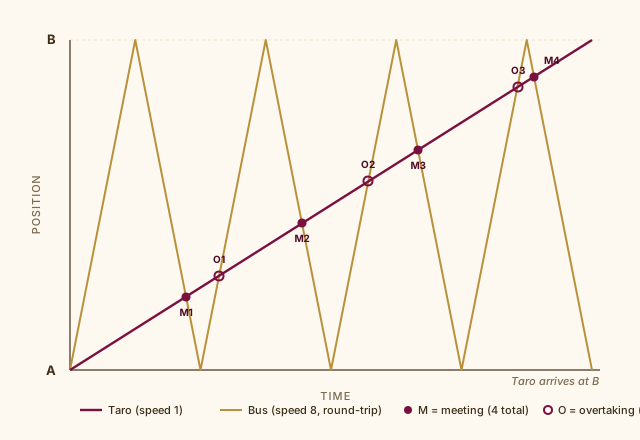
The time-distance diagram for the Taro and bus problem. Taro's path (the dark line) and the bus's path (the gold zigzag) intersect at seven points: four head-on meetings (filled circles, M1-M4) and three overtakings from behind (open circles, O1-O3). The answer is read off the diagram, not computed.
Now the problem is no longer hard. The places where the two paths intersect are exactly the moments when Taro and the bus are at the same position. When the bus's slope is negative — it is travelling B→A — and crosses Taro's path, the two are approaching each other: a meeting. When the bus's slope is positive — travelling A→B — and crosses Taro's path, the bus is overtaking from behind: an overtaking. We can count the intersections directly off the picture: four meetings and three overtakings. The answer is read off the diagram, not computed.
The first diagram failed. The second diagram succeeded. The mathematical content of the problem is identical in both cases — what changed is the carrying capacity of the representation. The same student, given only the line-segment tool, hits a ceiling. Given the time-distance tool, they walk through the problem. The skill the system is selecting for, when problems like this appear on the entrance exam, is not the ability to calculate. It is the ability to choose the right diagram.
This is why I describe the image skill not as "drawing pictures" but as choosing among diagrams. A student who can draw a line-segment diagram but does not know that the time-distance diagram exists, or does not know when to use it, will solve every distance problem in the curriculum until they meet a problem like Taro and the bus — and then they will stop. The boundary of their image skill is the boundary of their problem-solving capacity.
The translation that takes years
Once you see that the image skill is fundamentally about choosing among diagrams, the consequences for instruction become clear. A child needs to have more than one diagram available to them, and they need a developed sense of which to reach for. Neither of these is acquired in a week.
Reading a problem statement and producing the right kind of diagram — line segment for proportional relationships, area model for products, ratio table for comparison, time-distance diagram for motion with periodic structure — requires the student first to identify the structural class of the problem, and then to map the components of the language onto the corresponding parts of a spatial representation. Both steps have to be trained, and the second step is the more demanding one.
This is not a one-week curriculum item. It is a multi-year training. We observe that even strong students take roughly eighteen months to two years before the translation becomes fluent. Weaker students take longer. Some never reach fluency at all.
This is also why competent arithmetic instruction is so rare. Teaching a child to choose the right diagram requires the instructor to see the structure of the problem clearly enough to demonstrate the choice in front of the student. An instructor who only ever uses the line-segment diagram cannot teach the Taro and bus problem — not because the problem is too hard, but because their own diagrammatic vocabulary is too narrow. Many instructors are, in fact, in this position. The student is left to figure out the choice by chance, which most of them do not.
When a student becomes able to draw the right diagram before solving a problem, the difficulty ceiling and the success rate both rise sharply. When a student remains unable to do so, the volume of practice does not matter. The student is processing the same information bandwidth they were processing six months ago. The constraint is not motivation. It is bandwidth.
Why the industry teaches the diagram but not the reason
There is a strange pattern in Japan's major cram school industry. The diagrams themselves are taught. Line-segment diagrams, area figures, ratio tables, time-distance diagrams — these all appear in the standard curriculum. But the reason the diagram works is not taught.
A typical lesson runs: here is a "speed and distance" problem; here is the corresponding diagram; here is how to insert numbers into the diagram; here is the answer. The diagram appears as a kind of formula — a procedural tool you apply when you encounter a particular type of problem. The student is also expected to memorize a taxonomy of named problem types (the famous "tsurukame-zan," "differences problem," "age problem," and so on) and to associate each with a procedure.
What is missing is the underlying explanation. That the diagram is a means of compressing the problem's information into a form the mind can actually hold. That drawing the diagram is itself an act of thinking, not a record of having thought. That the choice of which diagram to draw is the part where the real work happens. That the named problem types are not categories of mathematical structure — they are categories of surface presentation, and a student who has internalized them as structural categories will be helpless the moment a problem appears in a form the taxonomy does not cover.
This is the failure mode hiding inside an industry that ostensibly teaches "thinking." The technique is taught. The reason for the technique is not. The named problem types are memorized in place of the underlying structures they were meant to point at. The student leaves the system having memorized hundreds of diagrams and dozens of problem labels without ever learning what either is for.
What gets repeated through every layer of the system — instructors who memorize their own training, parents who cannot evaluate whether the technique is being conveyed, textbooks that mirror the same procedural surface — is the appearance of structure-teaching without the substance of it. A child can sit inside this system for years and emerge as someone who can apply twenty memorized diagrams to twenty named problem types but cannot, when handed a novel situation, invent the twenty-first.
The flaw is in the exam itself
The point I have just made about the industry would be merely an internal critique if the exam were doing its job. It is not. The deeper problem is that the exam selects for the wrong skill in the first place.
A written paper test, scored on whether the final numerical answer is correct, is structurally unable to distinguish between two students who arrive at the same answer by very different paths. One student saw the structure of the problem, chose the right diagram, and read the answer off the picture. The other applied a memorized procedure to a problem they recognized as belonging to a named category. Both produce the same mark on the page. The system rewards them identically.
The result is predictable. A study technique that scores well on the exam without training the underlying skill comes to dominate the industry — because it is cheaper, easier to teach, and easier to evaluate. The exam, in other words, is producing exactly the gap I have been describing. Children spend years preparing for it using methods that will not be useful to them after the test, and the rewards of the system are calibrated to reinforce this.
To restate the position bluntly: it is the exam, not the student, that is the underlying problem. A method of preparation that achieves nothing for the student's life after the exam should not be capable of winning the exam. That it does is a structural flaw in how the selection is conducted.
A concrete proposal
The reform implied by the analysis is straightforward: introduce an oral component to the entrance exam. The constraints of time and personnel are real, and an oral exam at the scale of the current written exam is not realistic. But even a brief oral component — a few minutes per student in which the candidate is asked to explain why they chose a particular method, or why a particular diagram is appropriate to a problem they have just solved — would shift the incentive structure of the entire industry. The moment the exam selects for the ability to articulate the structural logic of a solution, study methods that train this ability begin to dominate, and study methods that bypass it (the memorize-the-procedure approach) lose their value.
This is not a radical pedagogical proposal. Oral examinations exist in many other educational traditions. The Japanese university system uses them. Doctoral examinations across the world use them. The reason they have not been introduced into junior high entrance examinations is operational, not principled.
For the families who are inside the current system, the practical implication is more immediate: training the image skill — choosing diagrams, articulating why a particular structure applies — produces both outcomes. Children trained this way score well on the written exam and retain a usable cognitive skill afterwards. The two goals are not in conflict; the appearance of conflict is an artifact of the industry's preferred method, not of the underlying material.
Beyond the exam — diagrams in adult work
Step out of the cram school and look at adult professional environments.
Consider what high-functioning workplaces actually produce. Strategy decks for executive meetings are built around diagrams — funnels, two-by-two matrices, system maps, value chains. Catalogs and product brochures rely on layout and visual structure to be read at all. Software architecture is communicated through component diagrams and sequence flows. Research papers are read first through their figures, and only afterwards through the text.
Now imagine any of these documents converted into pure prose. The page count would multiply. The reader would skim and put it down. The information would not actually be communicated. This is not because adults are visual learners or because attention spans have shortened. It is because the underlying principle is the same one that holds in arithmetic class: per unit of time, images carry more information than text. Adults who work effectively in modern organizations have, without articulating it, learned to think in diagrams. They translate complex situations into spatial structure as a basic operating habit.
The image skill, in other words, is not just a tool for solving entrance exam problems. It is the cognitive infrastructure for handling complexity in any field — strategy, engineering, science, design, law, medicine. The child who never learned to choose among diagrams for their math problems grows into an adult who cannot construct a clear slide, cannot read a research figure quickly, cannot map an unfamiliar system in their head.
What is being decided in the way a ten-year-old approaches an arithmetic problem is not really the entrance exam outcome. It is whether they will, twenty years later, be able to think in the medium their work will actually require them to think in.
The image skill — and what may be missing
The position I am describing is not a narrow pedagogical claim. It is an observation about a general cognitive capacity that, as far as I have been able to see from inside this industry, is rarely trained systematically anywhere — including in Western elite education.
Western elite training — and in particular Western business and management education — places a strong emphasis on argumentation, analysis, and articulation. MBA curricula, consulting firm onboarding, executive education programs: these are largely text and discussion. Frameworks, often visual ones, are taught, but the underlying skill of inventing the right diagram from first principles, when no framework applies, is not the explicit subject of training. The frameworks are taught as named tools, in a manner not unlike the way the Japanese cram-school industry teaches its named problem types.
This matters because the most important decisions in modern professional life are made about objects that are inherently structural: organizations, markets, systems, networks, supply chains. These objects are not naturally captured by argument; they are naturally captured by diagrams. Yet the elite cognitive apparatus aimed at these objects has been trained, on the whole, in language.
Japan's competitive arithmetic training happens — by accident, as I argued at the start — to be one of the rare educational systems in which the image skill is trained over years, in children, with the precision required to make it work. It does this almost despite itself: the industry teaches the diagrams as procedures, not as compression tools, and the students who succeed inside the system are often those who have intuited the underlying principle on their own, without it being articulated.
I am writing this from inside that industry, having watched the same gap repeatedly: children who could be trained in the image skill but are not, because the industry does not understand what it is doing. The skill is teachable. The conditions under which it actually gets taught are rare. There is no obvious reason these conditions could not be reproduced elsewhere.
Conclusion
Arithmetic was not designed to train the image skill. Japanese arithmetic instruction does not, as a system, know that it trains the image skill. The exam does not test for the image skill directly. None of this means the skill is not being trained. It is being trained — visibly, in front of me, in classrooms — and the small number of students who emerge with it intact carry a cognitive advantage that lasts the rest of their lives.
The diagnosis is not complicated. The industry teaches the diagrams as procedures rather than as tools of thought. The exam selects for procedural fluency rather than structural understanding. The two failures reinforce each other and produce a steady stream of students who can pass the test but cannot think about the structures it was meant to indicate.
The fix is also not complicated. Teach diagrams as compression tools. Teach the choice among diagrams as the actual cognitive operation. Add an oral component to the exam so that the structural reasoning behind a solution becomes part of what is scored. Each of these is implementable. None of them is being implemented.
If you are working in education, in cognitive science, in journalism on the limits of current educational systems, or in any field where the gap between language-based and structure-based thinking is visible, we are open to exchange. Inquiries from researchers and journalists are welcome.
Frequently asked questions
What do you mean by "image skill" — is this just visual learning style?
No. Visual learning style theory — the idea that some children are inherently "visual learners" while others are "auditory" or "kinesthetic" — has been largely discredited in cognitive science. What is being described here is different: a specific, trainable cognitive capacity to translate language into structural representation, hold that representation in working memory, and manipulate it. This capacity is, in principle, available to every child. It is not a learning style; it is a skill.
Are you saying that words and language are unimportant?
No. Language remains the primary medium through which problems are stated and discussed. The point is narrower: that the translation from language into structural form is itself a critical cognitive operation, and that it is the operation most consistently underdeveloped in students we see. Strong thinking moves fluidly between language and structure. Most students we encounter can only operate at one end.
If diagrams are so important, why doesn't the major cram school industry teach them better?
The diagrams are taught, in the sense that students are shown which figure to draw for which named problem type. What is not taught is why the diagram works, when to use which kind, and how to invent a new one when no template applies. Most instructors themselves received their training in this same procedural form. They cannot teach what was never explained to them. The result is a multi-decade industry that delivers the surface of the skill without the substance.
Won't training the image skill cost the student exam points?
No. Training the image skill produces both outcomes — strong written-exam performance and a retained cognitive skill afterwards. The two goals are not in conflict, although the cram-school industry's preferred procedural method makes it look as though they are. Children who learn to choose the right diagram and articulate why solve more difficult problems on the exam, not fewer.
Can adults still learn this skill?
In principle, yes. In practice, the gap is wide and the inertia is significant. An adult who has built their entire professional thinking on language-based reasoning has typically spent decades reinforcing the habit. Acquiring fluent translation between language and diagram in adulthood is possible but requires deliberate practice and is rarely undertaken. The reason we focus on children aged ten to twelve is that the cognitive plasticity for installing the skill is, in our experience, near its highest at that age.
Is this the same as "visualization" techniques in memory training or study skills books?
No. Memory visualization techniques — the method of loci, peg systems, and so on — are about converting information into images for retention. What is being described here is structural: it is about converting information into a representation that supports reasoning, not just recall. The diagram is a thinking tool, not a memory tool.