A foundation of judgment data that grounds education in evidence.
We structure expert judgment, and from it build every educational tool.
We take what a skilled solver notices and what they do, break it into the smallest steps, and turn it into data. We answer the world’s education challenges by delivering judgment.
CREATE BASE Learning OS in two minutes
Challenges facing education worldwide
- 70%01
Learning poverty
About 70% of 10-year-olds in low- and middle-income countries cannot read and understand a simple text.
World Bank / UNESCO et al., 2022 - −15pts02
A record fall in mathematics
The OECD average in mathematics fell by the largest margin in the history of PISA.
OECD, PISA 2022 - 44million03
Not enough teachers
The number of additional teachers the world needs by 2030.
UNESCO, 2024 - AI04
AI without structure
AI explanations come out in a different form every time. With no consistency, they cannot build on one another.
Even in high-scoring Japan,
learning does not last
Japan ranked first among OECD countries in PISA 2022 mathematics. Yet amid fierce entrance-exam competition and a heavy reliance on private tutoring outside school, the following is happening.
- 01
Left behind in group classes
Lessons move ahead of understanding. Some children will always fall behind; the system makes it unavoidable.
- 02
Progress stalls as problems get harder
Memorised methods only work up to a point. Once problems get harder, memorisation is no match for them.
- 03
Passing the exam, then stalling
Children who crammed their way in struggle after admission, burn out, and can no longer learn on their own.
- 04
Families push children too hard
Driven by the anxiety of exam competition, well-meaning parents force excessive study on their children. In Japan this is known as “educational abuse”.
Read more
Root-cause analysis
The causes of these challenges come down to three gaps in education: content, method and teachers. Trace those three further back, and they all lead to the same point.
Judgment is not part of what is taught
Procedures are taught, but not what to notice in order to use them. Half of judgment is missing.
Teaching has no grounds
Teachers simply follow the manual. With no line drawn between what to memorise and what to think about, teaching relies on repetition and memorised methods. Lessons that run ahead of understanding and inconsistent AI explanations come from the same place.
Too few teachers, too little expertise
There are not enough teachers, so subjects are taught by non-specialists, and expertise runs short as well.
One gap gives rise to several challenges.
| Gap | Learning poverty | Falling maths | Teacher shortage | AI without structure |
|---|---|---|---|---|
| Content Judgment is not taught | ● | ● | ● | |
| Method Teaching has no grounds | ● | ● | ● | |
| Teachers Too few, too little expertise | ● | ● | ● |
The three gaps keep producing one another
At the root is a stance: skip what should be learned, and get the answer by any means. People who learn that way teach the same way.
Teachers teach the way they were taught (Lortie, 1975). This is how the gaps are passed down from one generation to the next. Structure judgment, and the same cycle starts turning the other way.
There is one root. Judgment has never been structured.
What education should build is not the amount of knowledge, nor test scores. It is the ability to decide, in front of a problem you have never seen, what to notice and what to do.
Mathematics and language are not ends in themselves. Take in information, organise it, decide. We learn them as a means of processing information.
Structure judgment,
and answer every gap
CREATE BASE Learning OS removes the root cause itself: unstructured judgment. That is why it addresses all three gaps, in content, method and teachers, at the same time.
Judgment is not part of what is taught
Make judgment itself the content
What to notice and what to do are given names, so judgment itself can be taught and practised.
Teaching has no grounds
Separate what to memorise from what to think, and start from where learning stopped
Judgment is split into cue and response, so what to memorise (responses) and what to think about (cues) can be told apart, and you can see exactly which step a learner stopped at. Teaching gains grounds, and AI produces consistent explanations on the same structure.
Too few teachers, too little expertise
Deliver expertise as data
Expert judgment is stored as data, so it reaches every classroom at the same quality, even when a non-specialist is teaching.
What it means to structure judgment
An expert solver knows, the moment they see a problem, what to notice and what to do. We record that instant judgment as a pair, a cue (what to notice) and a response (what to do), and turn it into data. We call this pair a chain.
ExampleFractions with different denominators → find a common denominator
Through the lens of cognitive science
Experts see the deep structure of a problem
Novices sort problems by surface features; experts sort them by the principle they use. A cue puts that deep structure into words.Chi, Feltovich & Glaser, 1981
Expertise is a set of condition → action rules
Cognitive science models problem-solving knowledge as rules of the form “if this condition, then this action” (production rules). A chain has exactly this form.Newell & Simon, 1972 / Anderson, ACT-R
Experts cannot see their own judgment
The more expert people are, the more they overlook the steps novices need (the expert blind spot). A chain brings unconscious judgment into the open and gives it a name.Nathan & Petrosino, 2003
Named steps transfer to new problems
When each step of a solution is learned with a name for its purpose, learners can apply the method to problems they have never seen.Catrambone, 1998
What separating cue and response
makes possible
Splitting judgment into what to notice and what to do lets us draw lines that used to be blurred.
1. Separate what to memorise from what to think about
The problem is not memorising itself. It is memorising methods and answers.
The content of each response
Formulas, facts, procedures: “the angles of a triangle add up to 180°”, “how to find a common denominator”. The more automatic they are, the more room there is to think.
Which cue applies
What to notice in the problem in front of you. It changes with every problem, so memorising does not help. This is what we practise.
2. See exactly where a learner stopped
Knowing a chain does not mean being able to use it. Once you know which step failed, you know what to do.
- 1
Know
If they don’t know it, teach it.
- 2
Notice
If they don’t notice it, practise spotting it across many problems.
- 3
Use
If they get the operation wrong, practise the procedure.
3. Reorganise from any angle
The same chains can be rearranged by field, by type of difficulty, by curriculum, or for any purpose. They can be mapped to curricula outside Japan as well.
- A
By field
Geometry, ratio, speed… list the judgments used in each topic.
- B
By difficulty
Group the students who stall at the same step, and give them the same remedy.
- C
By curriculum
Map the same chains to Japanese grades, or to the grades and national standards of other countries.
One set of data,
many tools
These are just examples.
- Structured judgment dataEvery tool is derived from it
- Step-by-step explanationsCues and operations, one step at a time
- Slides and videoPause, rewind, repeat
- Interactive hintsOnly the next thing to notice
- DiagnosisFind the step where thinking stopped
- Personalised practicePractice that starts from that step
- Judgment flowchartsInformation and judgment on one page
An example of generated output: a judgment flowchart
All of the outputs above are made from the same structured data. One judgment flowchart is shown here. Explanations, animations, diagnosis and the rest can be tried in the case studies.
Boxes are information; gold bands are chains (cue → response). Starting from the given information, judgments build one on another until the answer. The judgment data behind it can be generated for any problem.
ProblemThe figure shows a square with sides of 12 cm, which is the net of a triangular pyramid. Points E and F are the midpoints of sides AB and AD. Find the volume of the pyramid in cm³.
GivenDerived informationAnswerChain (cue → response)
Mathematics is the first example
What we structured is not mathematics. It is expert judgment: what to notice and what to do, the moment you see a problem. That judgment exists in every field that has experts. Mathematics is the first example, showing that the method works.
The structure is not tied to a subject
A chain (cue → response) is not written in the vocabulary of mathematics. It is the shape of judgment itself: when you notice this condition, do this. So it can be written in the same form whatever the subject or field.
Already in use outside mathematics
We use the same structure, unchanged, for reading comprehension in Japanese and for learning counselling (diagnosing where a student is stuck). The method systematised in mathematics carried over without modification.
The procedure is the same in any field
Break the judgment of that field’s experts into cues and responses. Check it against real teaching or practice. Turn it into data. These three steps extend to languages, programming, professional certifications, corporate training: any domain where expert judgment exists.
Build the data once, and the tools follow
Once a body of judgment data exists, explanations, diagnosis, practice and flowcharts are derived from it. There is no need to rebuild materials for each field.
Mathematics is the proof of the method. The next field will be built together with experts in that field. Not only education: every domain where human judgment needs to be passed on is in scope.
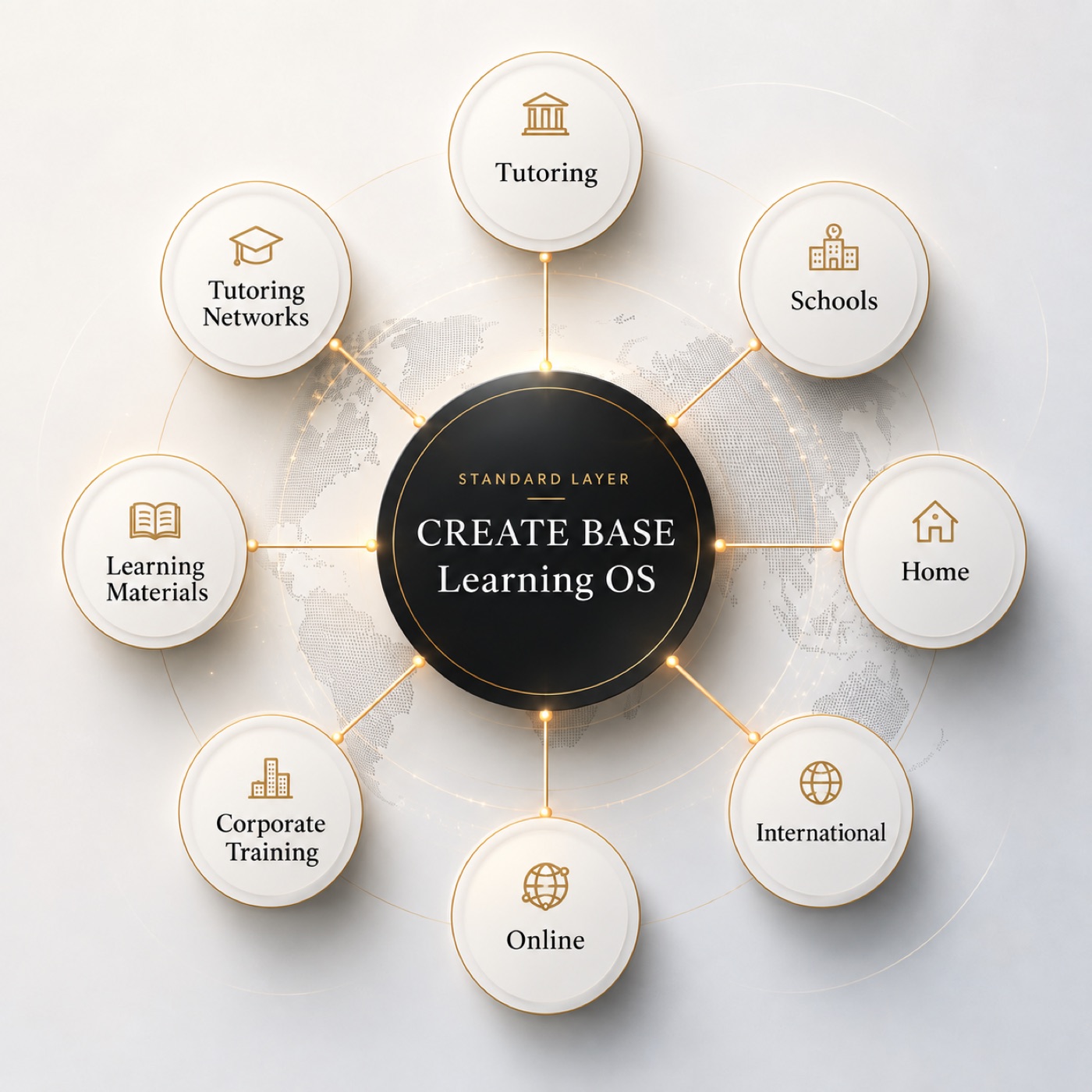
A standard layer beneath education
CREATE BASE does not compete with tutoring schools, schools or learning materials. It sits beneath them and reaches learners through all of these channels.
The more expert you are, the less you can see your own judgment. That is why structuring judgment has been so hard. At CREATE BASE, an expert who sees the solution the moment they look at a problem broke that instant judgment down into cues and responses, and structured it.
Expertise and articulation. Having both is what made it possible to systematise this structure while teaching for Japan’s most selective entrance exams. New chains can be created directly, or proposed by AI and adopted once an expert has checked them.
A structure built on one principle
cannot be reproduced
AI can produce explanations. But inside AI there is no consistent set of judgment points. CREATE BASE Learning OS supplies them to AI as structured data. One principle runs through that structure: a natural, unforced line of thought, grounded in the essentials. The surface output can be copied. A structure built up from a principle cannot be reproduced afterwards.
What AI never had
The text AI learned from contains procedures and answers. Why an expert noticed something and chose that procedure lives in the expert’s head, and was never written down. That is why AI’s explanations come out in a different shape every time.
One principle runs through everything
Not tricks or memorised shortcuts, but a line of thought grounded in the essentials, one that a person can follow naturally and without strain. Every chain is cut to this single standard. That is why the same structure carries across subjects and across fields. Materials pieced together, or explanations generated by AI problem by problem, do not come out this way.
So it cannot be reproduced
Only the output is visible; the structure beneath it is not. Collecting fragments will not give you the same structure unless you cut them again from one principle. Only an expert who sees the solution the moment they look at a problem, and who can put that judgment into words, can do that.
What grows is not subject prep,
but judgment
We do not build subject-by-subject exam preparation. We build the ability to judge for oneself. That is why the results reach beyond any single subject.
- As a result, students began to learn on their ownStudents who have internalised the structure of judgment do not wait to be taught. They find problems themselves and keep learning.
- One example: a student earned Cisco’s international CCNA certification at 15, entirely self-taughtThe same ability worked in a completely different field. It shows that this way of thinking carries over to other fields.
Japan’s selective junior high school entrance exams test reasoning, not calculation speed. At our classroom in Umeda, Osaka, we have taught structured judgment exactly as it is.
- Admissions to Japan’s most selective schoolsIncluding Nada (consistently among the top schools nationwide for University of Tokyo admissions), Todaiji Gakuen, Rakunan and Osaka Seiko Gakuin
- First place with full marks on a major tutoring chain’s mock examFull marks in all four subjects
- Several medallists in Japan’s Junior Mathematical Olympiad
Bring us your materials.
Past exam papers, problem books, the materials you teach from. A name or a short description is enough. We extract the judgments from them and return explanations, animations, flowcharts, practice and more. We look at the material first, then reply with what we can do and how long it would take.